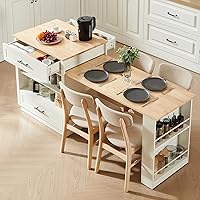
Kitchen Island Table Combos for Dining
A kitchen island and table combo can replace a separate dining spot when its height, seating and clearances fit your routine. Fixed island tables suit everyday meals, while extendable designs give you more surface only when you need it.
On this page (10 sections)
- Does a kitchen island and table combo work for dining?
- What should you measure before choosing one?
- Which type fits your dining routine?
- Which kitchen island table combos are worth comparing?
- Is an island table comfortable for everyday meals?
- What trade-offs come with a combo?
- How should you set up and care for an island table?
- What common mistakes should you avoid?
- How do you choose between the four styles?
- Are kitchen island and table combos right for your kitchen?
A kitchen island and table combo can work for dining when it gives your household enough seated space without blocking kitchen paths. A fixed island table suits everyday meals, while an extendable design can keep the footprint smaller between gatherings.
Check the surface height, usable length and room for seats before you choose. An island that looks like a table may still be awkward if you cannot pull a chair back or open a nearby appliance.
For more options, see our drop-leaf kitchen island guide and extendable kitchen island guide.
Does a kitchen island and table combo work for dining?
Yes, a combo works for dining when the seated surface and surrounding space fit your routine. The label alone does not tell you whether the top is comfortable for a full meal or whether the seats will obstruct traffic.
Start with the number of people who eat there most days. Then check the dimensions with seats in place, not just the bare island footprint.
A table-style island can be useful when you want a shared surface for meals and prep. But the dining position may compete with cabinet doors, a refrigerator path or the route between the kitchen and another room.
If you mainly need a compact spot for two, compare the layout advice in kitchen islands with seating for 2. For a larger group, consider the seating and spacing points in kitchen islands that seat 4.
What should you measure before choosing one?
Measure the island, the seats and the space people need to move. The open extension matters as much as the compact position if you plan to use both.
Write down these dimensions before shopping:
| Measurement | Why it matters |
|---|---|
| Closed width and depth | Confirms the everyday footprint fits |
| Extended length | Shows the full dining surface needed |
| Surface height | Helps you choose compatible chairs or stools |
| Seat width and pullback space | Helps each diner sit and leave comfortably |
| Clearance to counters and appliances | Keeps doors and work paths usable |
Mark the closed and extended outlines on the floor with painter's tape. Add the seat positions and pullback area, then check whether someone can pass while the seats are occupied.
Also measure the delivery route and the final turning space. Larger island tables can be heavy, and some models arrive in multiple boxes.
For more on circulation, see how much space to leave between a kitchen island and counter. If you are still deciding between stools and a more table-like setup, our kitchen island vs breakfast nook comparison can help.
Which type fits your dining routine?
A fixed island table works for a consistent dining area, while an extendable model fits households that need extra surface only sometimes. Choose based on your normal day, rather than the largest gathering you host once or twice a year.
| Style | Works well when | Check before buying |
|---|---|---|
| Fixed island table | You have room for its full size every day | Seat count, height and permanent floor space |
| Flip-top or drop-leaf | You want to expand one side or surface | How the top opens and where the added surface lands |
| Sliding extension | You want a longer table when guests arrive | Full extension length and support beneath the extended area |
| Rolling island with extension | You need to reposition it between tasks | Locking wheels, stability and the route when moved |
An extension creates more tabletop, but it also takes space from somewhere. Make sure the extended end does not block a doorway or force diners into a walkway.
If you plan to sit at the island often, review how much overhang island seating needs. Table-style designs may have a different leg and seat arrangement from a breakfast bar.
Which kitchen island table combos are worth comparing?
These four options show different approaches: fixed table-style surfaces, a flip-top extension and a sliding extension. Compare their dimensions and storage against the space you measured, since the designs serve different layouts.
Fixed kitchen island and table combos for daily meals
Fixed island tables make sense when you can leave the dining surface in place every day. They avoid the need to open an extension, but you need enough room for the full footprint.
The ONBRILL has a 61 in long, 31.5 in deep top and stands about 35.4 in high. Its engineered wood base has a walnut and white finish, and the tabletop has a realistic marble finish.
A 3-tier adjustable side shelf offers space for cutlery, condiments, napkins or small appliances. The table also has 2 AC outlets, 2 USB ports and a 2-meter power cord.
This model suits a household that wants a permanent table-height dining zone with some open storage close at hand. Skip it if you need to tuck the whole surface away, since its full 61 in length remains in the room every day.
The TRONLEE measures 63 in long by 31.5 in wide and 31.5 in high. Its high-density MDF tabletop and legs are 1.8 in thick, and the table includes 2 AC outlets and 2 USB ports.
The height is lower than the ONBRILL's, so compare it with the seats you already own. TRONLEE describes space for 4 to 6 people, but check whether that arrangement fits your room and desired spacing.
This pick makes sense if you prefer a lower fixed table and want lighting as part of the dining setup. It is a poor match for a kitchen that needs a narrow island or frequent repositioning.
Both fixed options include lighting, which may suit a dining area where ambiance is part of the plan. Keep the power cord and outlet placement in mind, and make sure the cord can reach without crossing a walkway.
Extendable kitchen island and table combos for flexible seating
An extendable island can serve as a compact prep surface and grow for meals. Check both the closed and open dimensions, along with the seat arrangement.
The St.Mandyu measures 19.7 in deep and 35.5 in high, with a flip-top that extends from 47 in to 89.6 in. It seats 2 to 4 people.
Its storage includes 3 drawers, a cabinet with an adjustable inner shelf, door storage and a spice rack. Seven casters support movement, and 4 have locking brakes.
Choose it when you want substantial storage in a rolling island and can make room for its full open length during meals. Skip it if you cannot clear nearly 90 in of floor space or prefer a fixed, table-like setup.
The Rymeera is 21.6 in deep and 36 in high. It has 2 cabinets, 2 adjustable shelves, 4 side-mounted spice racks and a drawer, plus 7 swivel casters.
Its top is solid rubberwood, while the body is high-density MDF and particleboard. It seats 2 to 4 people when extended.
This model suits someone who wants an extendable surface with a solid rubberwood top and enclosed storage. Skip it if you need a lightweight piece to move often; the island weighs 120 lb and ships in 2 boxes.
The two rolling models vary in depth and open length, so tape both footprints on the floor before deciding. Also consider whether you can lock the casters and keep the island steady when people are seated.
Is an island table comfortable for everyday meals?
It can be comfortable for daily meals if the height, knee space and seat position match the people using it. A counter-height design may feel different from a standard dining table, so check the dimensions against your chairs or stools.
Look at the underside as well as the top. A center support, cabinet or drawer can affect where legs fit, and a wide tabletop does not guarantee room for every seat.
Think about how long people sit there. A quick breakfast may suit a stool, while longer meals often call for a seat with a back and a footrest at a comfortable position.
For seat planning, use our guide to how many stools fit at a kitchen island. If you expect people to sit on two sides, review whether a kitchen island can seat people on both sides.
What trade-offs come with a combo?
A combo can save a separate furniture footprint, but it may give you less flexibility than a dedicated dining table. Storage, work space and seating all compete for the same area.
A fixed table can occupy useful floor space even when nobody is eating. An extendable model can reduce that problem, but its larger open size still needs a clear place to land.
Rolling islands add flexibility, though they need a stable position for dining. Locking casters help hold a cart in place, but check the manufacturer's instructions and do not stand or sit on the island.
Storage can also make the base bulkier. Drawers, shelves and cabinets are useful only if doors can open and diners can still sit comfortably.
A combo also asks you to share one surface between food preparation and meals. Plan where you will put small appliances, dishes and serving items when the top is being used for dinner.
The top material affects day-to-day care. For a closer look at common surfaces and their care needs, see kitchen cart top materials.
How should you set up and care for an island table?
Set up the island on a flat, clear surface, then check that it sits level and that every fastener is secure before use. Follow the assembly instructions for the specific model, especially when the unit is heavy or arrives in separate packages.
Plan the final position before assembly if the island will be difficult to turn through a doorway afterward. Keep the power cord away from the walking route, and leave access to outlets, drawers and cabinet doors.
For a rolling island, lock the brakes before preparing food or sitting down. Move it only when the top is clear and the route is open, then lock it again in its working position.
Use a cutting board for chopping and wipe spills promptly. The ONBRILL and TRONLEE have faux marble finishes, while the Rymeera has a rubberwood top; follow the care instructions for the chosen surface and avoid leaving moisture around seams or edges.
Keep the extended surface within its intended use. Do not sit or stand on an island unless its instructions explicitly allow that use, and do not place more weight on shelves or drawers than the maker permits.
What common mistakes should you avoid?
The most common mistake is measuring only the island's closed footprint. The full open length, seats, pullback room and appliance paths determine whether the combo works once someone sits down.
Another mistake is choosing by advertised seat count alone. Check the usable edge length and leg positions, then compare the arrangement with the people and chairs you actually plan to use.
Don't assume an island height matches your current stools. Compare the surface height, seat height and room for knees, then check whether a footrest lands at a comfortable position.
It is also easy to overlook delivery and assembly. A 120 lb piece or a model sent in multiple boxes may need extra help to move and assemble, so plan for the package route and clear floor space before it arrives.
Finally, think through daily access. A spice rack may be convenient, but a cabinet door that opens into a chair can make the dining position frustrating.
How do you choose between the four styles?
Choose by how often you need dining space and what your kitchen can hold. A fixed top fits a dedicated dining zone, while a shorter extendable island suits a room that needs open floor space between meals.
- Pick the ONBRILL if you want a fixed 61 in surface and open shelf storage.
- Pick the TRONLEE if you want a fixed, lower table with a faux marble finish and lighting.
- Pick the St.Mandyu if you need substantial drawers and cabinet storage with a flip-top that opens very wide.
- Pick the Rymeera if you want an extendable surface with a rubberwood top and enclosed storage.
Before you decide, compare each product's dimensions with your taped floor plan. Confirm the seat height, route around the island and space needed for drawers, cabinet doors and appliance access.
Are kitchen island and table combos right for your kitchen?
A kitchen island and table combo is a good fit when one piece can handle your regular meals without crowding the room. Choose a fixed table for a permanent dining place, or an extendable island when you can use a smaller surface most days.
If your main concern is fitting seats, start with the kitchen island seating dimensions guide. If you need a separate dining zone, compare an island with a breakfast nook before giving up floor space to a larger combo.
Frequently asked questions
Can a kitchen island and table combo replace a dining table?
It can replace a dining table if the seated surface fits your usual group and leaves enough room to pull out chairs and walk around it. Check the height, legroom, extension size and nearby clearances before buying.
A compact island may work for daily meals but feel tight for larger gatherings.
What height should a kitchen island dining table be?
Match the table height to the seats you plan to use, then check the dimensions before choosing stools or chairs. A counter-height surface generally calls for taller seating than a standard dining table.
Measure the seat height and space beneath the top so knees and footrests fit.
Are extendable kitchen island tables practical?
An extendable island table is practical when you can use the smaller footprint most days and have clear floor space for the full extension. Measure the open length and the paths around it.
Also consider whether moving parts or casters need to be secured before people sit down.
How much clearance does an island table need?
Allow enough room to pull seats back and pass behind them, then check the kitchen's main walking routes and appliance doors. The needed clearance depends on your layout and how people move through it.
Mark the island and chair positions on the floor to check the fit before ordering.
Should I choose a fixed or extendable island table?
Choose a fixed island table if you have room for its full footprint every day and want a simple dining surface. Pick an extendable model if you need a smaller prep area most of the time and can clear space for meals.
Compare both sizes, storage and seating details.